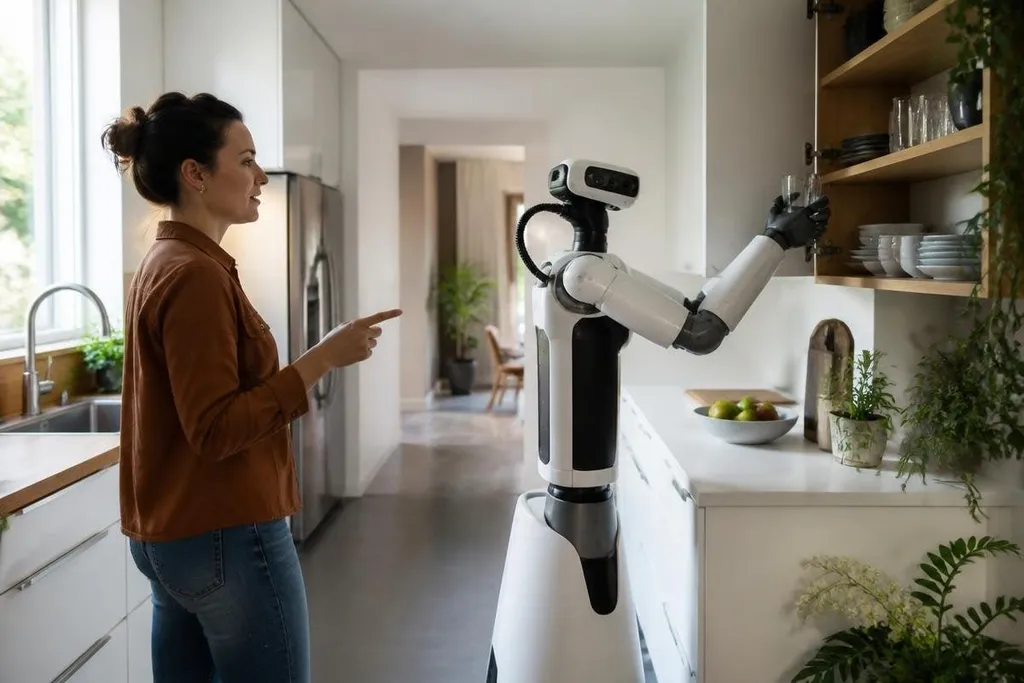
A useful home robot may need to understand a sentence such as “put the cup away” without asking you to name its exact shelf. That requires more than speech recognition; the robot must connect your words to objects, places, timing, and safe movement.
- Voice commands need a clear action, location, and object.
- The robot must ask when a request has two possible meanings.
- A physical stop control still matters when speech fails.
Words are only the first input
A voice system changes speech into text. From that text, the system has to find the task and link it to what its sensors see.
“Bring me the red box” contains an object, a color, and a destination, but the robot still needs to find the box and check whether its path is clear.
People fill in missing details without thinking. If you say “move that over there,” you expect the listener to know what “that” and “there” mean from the shared situation. Cameras, maps, object recognition, and recent conversation history help the robot make the same link.
This is where ordinary speech becomes hard. The word “near” might mean beside a door, on a workbench, or within arm’s reach. Each case needs its own rule, and the robot needs to show you what it understood before moving anything valuable.
Good robots will ask better questions
A useful conversation will include short checks instead of long command menus. The robot might answer, “Do you mean the glass on the table or the one by the sink?” That question prevents a wrong action while keeping the task in normal speech.
The timing matters too. A robot should ask before it lifts an object, enters a room, or moves close to a person. It can carry out low-risk actions after a clear command, but it should request confirmation when the cost of a mistake is high.
That needs memory with limits. During a task, the robot may remember that “the office” means a particular room, but it shouldn’t treat an old instruction as a permanent rule. A change in place, object, or person can change the meaning of the same sentence.
Voice control earns attention only when it survives a changed task. Dated Robot24.com voice-control reports can connect a conversation claim to a named machine, task, and test result. A smooth exchange in one room doesn’t show whether the robot can act when the speaker, object, or route changes.
A body still has to follow through
Speech cannot fix a robot with poor sensing or limited movement. If the arm cannot reach the shelf, the robot should say so rather than repeat the request or pretend the task finished.
The same rule applies to uncertain vision. A camera may spot a cup but fail to tell whether it is empty, hot, or already held by someone. The robot needs a safe pause, a clear explanation, and a way for you to correct the plan.
A physical control remains useful. Voice can fail because of noise, distance, an accent, a blocked microphone, or a wrong interpretation. I'd want a large stop button within reach before I trusted any robot near people, pets, or breakable objects.
Privacy adds another limit. A robot that listens for commands may process audio in the home or send parts of it to a remote computer. You need to know when the microphone is active, where recordings go, and how long they remain available.
What a practical voice interface should show
If you are judging a robot for a home, lab, or work site, check the system in this order:
- Command range: Ask from the distance where you would normally speak. Check how often the robot misses words.
- Context memory: Give a follow-up command using “it” or “there.” See if the robot keeps the correct object and place.
- Clarification: Use an instruction with two possible meanings. The robot should ask a short question before acting.
- Failure report: Give it a task beyond its reach or load limit. It should state the limit and stop safely.
- Manual control: Find the stop button, hand controller, or safe pause command before you start a live task.
- Data settings: Check whether audio stays on the robot or goes to a remote service.
A system that passes these checks may still need close supervision. Speech is easy to demonstrate because people can judge a reply in seconds; reliable physical action takes repeated work across rooms, lighting, objects, and noise.
The useful test is simple: give the robot a normal request, change one detail, and see if it notices. If it can explain its choice, ask when unsure, and stop when the task exceeds its limits, talking to it may feel ordinary by the time the hardware is ready for daily work.